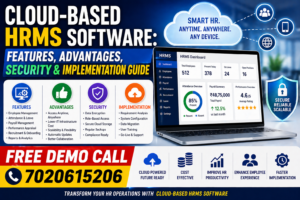
In today’s digital era, businesses are rapidly shifting towards automation and cloud-based solutions to streamline operations and improve efficiency. One of the most critical systems for any organization is Cloud-Based HRMS Software. A Human Resource Management System (HRMS) helps organizations manage employee data, payroll, attendance, recruitment, performance, and compliance in a centralized digital platform.Cloud-Based HRMS Software

Cloud-Based HRMS Software offers flexibility, scalability, and cost efficiency, making it ideal for small, medium, and large enterprises. Companies in India are increasingly adopting cloud HR solutions to improve productivity, reduce manual work, and ensure compliance with labor laws.
This guide will cover features, advantages, security measures, and implementation steps for Cloud-Based HRMS Software, along with how PJSoftTech HRMS Software can help your business grow efficiently.
What is Cloud-Based HRMS Software?
जाहिरात / पोस्ट मधील मुख्य माहिती व मुद्दे
Cloud-Based HRMS Software is a web-based system that stores HR data on secure cloud servers instead of local computers. It allows HR teams, managers, and employees to access HR services from anywhere using the internet.
Unlike traditional HR software installed on a local system, cloud HRMS offers:
- Remote accessibility
- Automatic updates
- Data backup and recovery
- Scalable storage
This makes Cloud HRMS Software a smart choice for modern businesses.
Key Features of Cloud-Based HRMS Software
1. Employee Information Management
A centralized employee database stores personal details, job roles, documents, and work history. HR teams can easily search, update, and manage employee records.
2. Payroll Management
Cloud HRMS automates salary processing, tax calculations, PF, ESI, and payslip generation. This reduces errors and saves time.
3. Attendance & Time Tracking
Attendance can be recorded using biometric devices, mobile apps, or web portals. Real-time tracking helps monitor employee productivity.
4. Leave Management System
Employees can apply for leave online, and managers can approve requests instantly. HRMS tracks leave balances automatically.
5. Recruitment & Onboarding
Cloud HRMS supports job posting, applicant tracking, interview scheduling, and onboarding workflows, making hiring faster and more efficient.
6. Performance Management
Organizations can set goals, conduct appraisals, and track employee performance using built-in evaluation tools.
7. Employee Self-Service Portal
Employees can view payslips, apply for leave, update personal details, and download documents without HR intervention.
8. Compliance & Reporting
HRMS ensures compliance with government regulations and generates statutory reports for audits.
9. Mobile App Integration
Many cloud HRMS platforms offer mobile apps for employees and HR teams, increasing accessibility.
10. Analytics & Dashboards
Advanced dashboards provide insights into workforce performance, attendance trends, and payroll data.
Advantages of Cloud-Based HRMS Software
1. Cost-Effective Solution
Cloud HRMS eliminates the need for expensive hardware and IT infrastructure. Businesses pay only for what they use.
2. Easy Accessibility
Employees and HR managers can access the system anytime, anywhere, which is ideal for remote teams.
3. Scalability
As your business grows, cloud HRMS can scale easily without additional installation costs.
4. Automatic Updates
Software updates and new features are automatically added without manual installation.
5. Improved Data Accuracy
Automation reduces human errors in payroll, attendance, and compliance records.
6. Enhanced Productivity
HR teams spend less time on manual tasks and focus on strategic activities like employee engagement and talent management.
7. Paperless HR Operations
Cloud HRMS promotes digital documentation, reducing paperwork and improving efficiency.
Security in Cloud-Based HRMS Software
Security is one of the biggest concerns for organizations when using cloud solutions. Modern Cloud HRMS platforms follow strict security protocols to protect sensitive HR data.
Key Security Measures
1. Data Encryption
All data is encrypted during transmission and storage to prevent unauthorized access.
2. Role-Based Access Control
Only authorized users can access specific data based on their roles.
3. Regular Backups
Automatic data backups ensure data recovery in case of system failure.
4. Secure Cloud Servers
Reputable HRMS providers use certified data centers with high security standards.
5. Multi-Factor Authentication (MFA)
Additional authentication layers ensure secure login.
Implementation Guide for Cloud-Based HRMS Software
Step 1: Assess Business Requirements
Identify HR processes that need automation such as payroll, attendance, recruitment, or compliance.
Step 2: Choose the Right HRMS Provider
Select a reliable software provider like PJSoftTech HRMS Software, which offers customizable features for Indian businesses.
Step 3: Data Migration
Transfer employee data from manual records or legacy systems to the cloud platform.
Step 4: System Configuration
Customize HRMS modules according to company policies and workflows.
Step 5: Employee Training
Train HR staff and employees to use the system effectively.
Step 6: Go Live
Launch the system and monitor performance to ensure smooth operations.
Step 7: Continuous Optimization
Analyze system usage and optimize processes for better productivity.
Why Choose PJSoftTech Cloud-Based HRMS Software?
PJSoftTech HRMS Software is a powerful cloud-based solution designed for Indian businesses. It offers:
- Complete payroll and attendance automation
- Employee self-service portal
- Compliance-ready reports
- Mobile app support
- Secure cloud infrastructure
- Customizable modules for different industries
Whether you are a startup, SME, or large enterprise, PJSoftTech HRMS Software helps streamline HR operations and improve workforce management.
👉 FREE ACCOUNT CALL 7020615206
Use Cases of Cloud-Based HRMS Software
1. Small Businesses
Automates HR tasks without hiring a large HR team.
2. Medium Enterprises
Improves efficiency with centralized HR operations.
3. Large Enterprises
Handles large workforce data with advanced analytics and compliance management.
4. Remote Workforce
Enables employees to access HR services from anywhere.
5. Multi-Branch Organizations
Centralized management of employees across multiple locations.
Future of Cloud-Based HRMS Software
Cloud HRMS is evolving with AI, machine learning, and automation. Future trends include:
- AI-based recruitment tools
- Predictive analytics for HR decisions
- Chatbots for employee support
- Integration with ERP and CRM systems
- Blockchain-based data security
Businesses adopting cloud HRMS today will gain a competitive advantage in workforce management.
👉 FREE ACCOUNT CALL 7020615206
Frequently Asked Questions
1. What is Cloud-Based HRMS Software?
Cloud HRMS is an online system for managing HR operations like payroll, attendance, and employee data.
2. Is Cloud HRMS secure?
Yes, it uses encryption, secure servers, and role-based access controls.
3. Can small businesses use Cloud HRMS?
Yes, it is ideal for small, medium, and large businesses.
4. Does HRMS support payroll automation?
Yes, it automates salary, tax, and statutory compliance.
5. What is an employee self-service portal?
It allows employees to view payslips, apply leave, and update personal details.
6. Can Cloud HRMS integrate with biometric devices?
Yes, many systems support biometric attendance integration.
7. Does PJSoftTech provide Cloud HRMS?
Yes, PJSoftTech offers advanced cloud-based HRMS solutions.
8. How much does Cloud HRMS cost?
Cost depends on features, number of users, and customization.
9. Can HRMS handle remote employees?
Yes, cloud access allows remote workforce management.
10. What reports can HRMS generate?
Payroll reports, attendance reports, compliance reports, and performance analytics.
11. Is training required to use HRMS?
Basic training is recommended for HR staff and employees.
12. Can HRMS help with recruitment?
Yes, it supports applicant tracking and onboarding.
13. How long does implementation take?
Implementation time varies from a few days to weeks.
14. Does HRMS support mobile apps?
Yes, many systems provide mobile applications.
15. Can HRMS be customized?
Yes, most cloud HRMS platforms offer customization options.
16. What is the difference between HRMS and payroll software?
HRMS includes payroll plus other HR functions like recruitment and performance management.
17. Does Cloud HRMS require IT infrastructure?
No, it works on cloud servers, reducing IT hardware costs.
18. Can HRMS handle statutory compliance in India?
Yes, it supports PF, ESI, TDS, and labor law compliance.
19. How does HRMS improve productivity?
It automates manual HR tasks, saving time and reducing errors.
20. Why choose PJSoftTech HRMS?
It is secure, scalable, customizable, and designed for Indian businesses.
Cloud HRMS Software, HRMS software India, cloud HR software, HR management system, payroll software India, attendance management system, employee management software, cloud payroll system, HR automation software, HRMS features, HRMS advantages, HRMS security, HRMS implementation, online HR software, cloud HR platform, PJSoftTech HRMS, HRMS for small business, HRMS for enterprises, human resource software, cloud-based employee management
- Managing Academic and Administrative Staff Effectively Using Employee Management Software
- Employee Performance Management Using HR Software: Tracking KPIs, Appraisals, and Productivity Digitally
- Employee Appraisal and Performance Tracking System: Benefits of Using Employee Management Software
- How to Choose the Right Employee Management Software for Your Organization: A Complete Buyer’s Guide
- HRMS vs Employee Management Software: Key Differences, Benefits, and Use Cases

Serch Your Dream Jobs