In today’s digital-first business environment, organizations are rapidly adopting HRMS software architecture to streamline human resource operations. From payroll automation to attendance tracking, employee onboarding, and performance management, Human Resource Management System (HRMS) architecture plays a critical role in modern enterprises.
Understanding HRMS software architecture, modules, integrations, and data flow helps companies select the right HR solution and maximize operational efficiency. This blog provides a complete technical and business-friendly explanation of how HRMS systems work internally and why platforms like PJSoftTech HRMS Software are becoming the preferred choice for Indian companies.
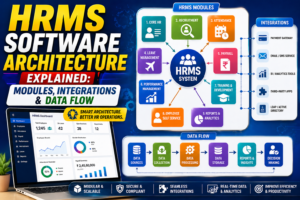
HRMS software architecture refers to the design structure of HR management software, including system components, data flow, integrations, security layers, and modules.
It defines how employee data is stored, processed, and accessed across different HR functions such as payroll, attendance, recruitment, and performance management.
A well-designed HRMS architecture ensures:
High performance
Data security
Scalability
Easy integrations
Real-time processing
Core Components of HRMS Software Architecture
1️⃣ Presentation Layer (User Interface Layer)
This is the front-end layer where users interact with the HRMS system.
Users include:
HR managers
Employees
Admin staff
Managers
Features:
Web dashboard
Mobile app interface
Employee self-service portal
2️⃣ Application Layer (Business Logic Layer)
This layer contains the core HR business rules and workflows such as:
Payroll calculation logic
Leave approval workflows
Attendance rules
Performance evaluation algorithms
It ensures automation and accurate HR processing.
3️⃣ Data Layer (Database Layer)
The data layer stores all HR data including:
Employee profiles
Attendance logs
Salary records
Tax and compliance data
Performance history
Modern HRMS uses relational databases or cloud storage systems for secure data management.
4️⃣ Integration Layer (API & Middleware Layer)
This layer connects HRMS with external systems like:
Biometric devices
Accounting software
ERP systems
Payment gateways
Government portals
Integration APIs ensure smooth data exchange between systems.
5️⃣ Security Layer
Security is a critical part of HRMS architecture. It includes:
Role-based access control
Data encryption
Multi-factor authentication
Audit logs
This protects sensitive employee data and ensures compliance with data privacy laws.
Key HRMS Modules Explained
1. Employee Information Management Module
This module stores employee master data including:
Personal details
Job role
Department
Salary structure
Documents
2. Attendance & Time Tracking Module
Tracks employee working hours using:
Biometric devices
RFID cards
Mobile GPS tracking
Web check-in
3. Payroll Management Module
Payroll module automates:
Salary calculation
PF, ESI, TDS
Incentives and bonuses
Payslip generation
Bank transfer integration
4. Leave Management Module
Manages:
Leave requests
Approval workflows
Leave policies
Holiday calendars
5. Recruitment & Onboarding Module
Handles hiring workflow such as:
Candidate tracking
Offer letters
Document verification
Training schedules
6. Performance Management Module
Used for:
KPIs tracking
Appraisal cycles
Feedback management
Goal setting
7. Employee Self-Service Module
Allows employees to:
Apply leave
Download payslips
Update personal data
View attendance
8. Compliance & Statutory Module
Ensures compliance with Indian laws like:
PF
ESI
Labour Codes
Income Tax
FREE ACCOUNT CALL 7020615206
Get a free HRMS account and explore powerful modules today.
HRMS Integrations Explained
Modern HRMS software integrates with multiple systems to ensure automation and accuracy.
🔗 Common HRMS Integrations
✔ Biometric Devices
Attendance data syncs automatically into HRMS.
✔ Accounting Software
Payroll data integrates with Tally, SAP, or accounting systems.
✔ ERP Systems
HRMS connects with enterprise resource planning platforms for unified business operations.
✔ Payment Gateways & Banks
Direct salary transfer through bank APIs.
✔ Government Portals
Automatic PF, ESI, and tax compliance reporting.
HRMS Data Flow Explained
Understanding data flow in HRMS software is important for companies and developers.
Step-by-Step HRMS Data Flow
1️⃣ Employee data entry in HRMS 2️⃣ Attendance data synced from biometric device 3️⃣ Payroll calculations processed 4️⃣ Tax and compliance deductions applied 5️⃣ Payslip generation 6️⃣ Salary transfer via bank integration 7️⃣ Reports and analytics generated
This automated data flow eliminates manual errors and improves efficiency.
Why PJSoftTech HRMS Software Architecture Stands Out
PJSoftTech HRMS Software is designed with a modern, scalable, and secure architecture tailored for Indian businesses.
Key Architecture Benefits
Cloud-based scalable infrastructure
Secure data encryption
Modular architecture for customization
API-based integrations
High-performance analytics dashboards
Mobile-friendly UI
Multi-branch and multi-company support
PJSoftTech HRMS architecture is suitable for startups, SMEs, and large enterprises.
FREE ACCOUNT CALL 7020615206
Start your digital HR transformation with PJSoftTech today.
Advantages of Modern HRMS Architecture
1. Scalability
Cloud architecture supports business growth without system upgrades.
2. High Security
Encrypted databases and role-based access protect employee data.
3. Automation
Automated workflows reduce HR workload and errors.
4. Real-Time Processing
Attendance, payroll, and reports are updated instantly.
5. Integration Capability
APIs allow seamless integration with other business systems.
Future Trends in HRMS Architecture
Microservices Architecture
Modular services improve performance and scalability.
AI & Machine Learning Integration
Predictive analytics and smart HR recommendations.
Blockchain for HR Data
Ensures tamper-proof employee records.
Mobile-First HRMS
Mobile apps will become the primary HR access platform.
Frequently Asked Questions (FAQ)
1️⃣ What is HRMS software architecture?
It is the structural design of HRMS system components, modules, integrations, and data flow.
2️⃣ Why is HRMS architecture important?
It ensures performance, security, scalability, and system reliability.
3️⃣ What are the main layers of HRMS architecture?
Presentation layer, application layer, data layer, integration layer, and security layer.
4️⃣ What modules are included in HRMS?
Employee management, payroll, attendance, leave, recruitment, performance, compliance, and self-service.
5️⃣ How does HRMS integrate with biometric devices?
Through APIs and middleware that sync attendance data automatically.
6️⃣ Is cloud HRMS better than on-premise?
Yes, cloud HRMS offers scalability, security, and remote access.
7️⃣ How secure is HRMS data?
Modern HRMS uses encryption, role-based access, and audit logs.
8️⃣ Can HRMS integrate with accounting software?
Yes, most HRMS systems integrate with accounting and ERP platforms.
9️⃣ What is HRMS data flow?
It is the process of collecting, processing, storing, and reporting HR data.
🔟 Does PJSoftTech HRMS support integrations?
Yes, PJSoftTech supports biometric, accounting, ERP, and bank integrations.
1️⃣1️⃣ Can HRMS handle multi-branch companies?
Yes, it supports multi-location and multi-company management.
1️⃣2️⃣ How long does HRMS implementation take?
It depends on company size, usually from a few days to weeks.
1️⃣3️⃣ Can HRMS be customized?
Yes, modular architecture allows customization.
1️⃣4️⃣ Does HRMS generate reports?
Yes, it provides payroll, attendance, compliance, and performance reports.
1️⃣5️⃣ What database is used in HRMS?
SQL, NoSQL, or cloud databases depending on the system design.
1️⃣6️⃣ Can HRMS run on mobile devices?
Yes, mobile apps are available for employees and HR teams.
1️⃣7️⃣ Is HRMS suitable for small businesses?
Yes, cloud HRMS is affordable and scalable for SMEs.
1️⃣8️⃣ Does HRMS support compliance reporting?
Yes, it supports PF, ESI, TDS, and Indian labour laws.
1️⃣9️⃣ What is middleware in HRMS?
Middleware connects HRMS with external systems like biometrics and banks.
2️⃣0️⃣ How to get PJSoftTech HRMS demo?
You can call PJSoftTech for a free demo account.
HRMS Software architecture, HRMS modules, HRMS integrations, HRMS data flow, HR management system architecture, payroll software architecture, attendance management system, cloud HRMS architecture, HRMS India, HR automation system, HR software modules, HRMS security, HRMS API integration, employee management system, HR analytics software, PJSoftTech HRMS, best HRMS software India, HRMS system design, HR digital transformation, enterprise HRMS software

 Serch Your Dream Jobs