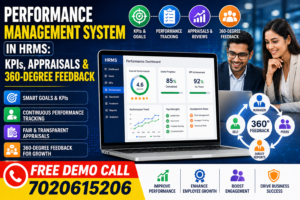
In today’s fast-paced business environment, organizations must continuously evaluate and improve employee performance to stay competitive. A Performance Management System in HRMS plays a crucial role in aligning employee goals with organizational objectives, tracking Key Performance Indicators (KPIs), conducting appraisals, and implementing 360-degree feedback mechanisms. Performance Management System in HRMS
A modern HRMS Performance Management System not only automates evaluation processes but also helps organizations build a culture of continuous improvement and employee engagement.
What is a Performance Management System in HRMS?
जाहिरात / पोस्ट मधील मुख्य माहिती व मुद्दे
A Performance Management System (PMS) in an HRMS (Human Resource Management System) is a digital framework used to plan, monitor, review, and improve employee performance. It integrates goal setting, KPI tracking, appraisals, feedback, and performance analytics into one centralized platform.
Unlike traditional manual appraisal systems, an HRMS-based PMS ensures transparency, accuracy, and real-time performance insights.
Why Performance Management System is Important for Organizations
A robust Performance Management System in HRMS helps organizations:
Improve employee productivity
Align individual goals with business objectives
Enhance employee engagement and motivation
Provide fair and data-driven appraisals
Identify training and development needs
Reduce employee turnover
With automation, HR teams can save time and focus on strategic initiatives rather than paperwork.
Key Components of Performance Management System in HRMS
1. Key Performance Indicators (KPIs)
KPIs are measurable values that determine how effectively employees achieve business objectives. In HRMS, KPIs are predefined metrics aligned with roles and responsibilities.
Common KPI examples include:
Sales targets
Customer satisfaction scores
Project completion rates
Attendance and punctuality
Quality of work
Team collaboration metrics
A well-designed KPI framework ensures employees understand expectations and can track their progress in real time.
2. Employee Appraisals
Appraisals are periodic evaluations of employee performance. A digital HRMS Performance Management System automates appraisal workflows and eliminates bias.
Types of appraisals in HRMS include:
Annual performance appraisal
Quarterly reviews
Probation evaluation
Promotion appraisal
Salary increment appraisal
With automated appraisal cycles, managers can provide structured feedback and documentation.
👉 FREE ACCOUNT CALL 7020615206
3. 360-Degree Feedback System
A 360-degree feedback system collects performance feedback from multiple sources such as:
Managers
Peers
Subordinates
Self-assessment
Clients
This holistic approach ensures fair evaluation and helps employees understand their strengths and areas for improvement.
How HRMS Improves Performance Management
Automation of Performance Reviews
HRMS automates goal setting, evaluation cycles, and rating calculations, reducing manual errors and saving HR time.
Real-Time Performance Tracking
Managers can monitor employee performance dashboards and KPI reports instantly.
Data-Driven Decision Making
HRMS provides analytics and insights that help in promotions, training programs, and workforce planning.
Employee Self-Service Portals
Employees can view their performance goals, feedback, and appraisal results, increasing transparency and engagement.
Role of PJ SoftTech Software in Performance Management
PJ SoftTech software offers an advanced HRMS Performance Management System that simplifies KPI tracking, appraisals, and 360-degree feedback processes.
With PJ SoftTech HRMS, organizations can:
Define role-based KPIs
Automate appraisal workflows
Collect multi-source feedback
Generate performance analytics reports
Integrate performance data with payroll and HR modules
PJ SoftTech software ensures a user-friendly interface, secure data management, and scalable solutions suitable for startups and enterprises alike.
Benefits of Performance Management System in HRMS
1. Improved Employee Productivity
Employees understand expectations clearly and work towards measurable goals.
2. Transparent Appraisal Process
Digital records ensure fair and unbiased evaluations.
3. Enhanced Employee Engagement
Continuous feedback boosts motivation and performance.
4. Better Talent Development
HRMS identifies skill gaps and suggests training programs.
5. Strategic Workforce Planning
Data insights help in promotions, succession planning, and workforce optimization.
Best Practices for Implementing Performance Management System
Define clear KPIs aligned with business goals
Conduct regular feedback sessions
Use continuous performance monitoring instead of annual reviews
Train managers on performance evaluation techniques
Encourage self-assessment and peer feedback
Use HRMS analytics for decision-making
Future Trends in Performance Management Systems
AI-driven performance analytics
Continuous performance feedback models
Integration with learning management systems (LMS)
Predictive performance insights
Personalized performance development plans
Modern organizations are shifting from annual appraisals to continuous performance management using HRMS platforms.
👉 FREE ACCOUNT CALL 7020615206
Frequently Asked Questions (FAQs)
1. What is a Performance Management System in HRMS?
It is a digital system used to track, evaluate, and improve employee performance using KPIs, appraisals, and feedback tools.
2. What are KPIs in HRMS?
KPIs are measurable performance metrics used to evaluate employee productivity and goal achievement.
3. What is 360-degree feedback?
It is a feedback system where employees receive evaluations from managers, peers, subordinates, and clients.
4. How does HRMS automate appraisals?
HRMS automates evaluation workflows, rating calculations, and documentation processes.
5. Why is performance management important?
It helps organizations improve productivity, engagement, and business outcomes.
6. Can HRMS reduce appraisal bias?
Yes, digital data and structured evaluation reduce human bias.
7. How often should performance reviews be conducted?
Quarterly or continuous reviews are recommended instead of annual appraisals.
8. What industries use HRMS performance systems?
All industries including IT, manufacturing, healthcare, education, and finance.
9. Is performance data secure in HRMS?
Yes, modern HRMS systems use secure databases and encryption.
10. Can employees view their performance reports?
Yes, employee self-service portals allow access to performance dashboards.
11. How does performance management improve employee retention?
Continuous feedback and recognition increase employee satisfaction and reduce turnover.
12. What is the role of managers in HRMS performance management?
Managers set goals, evaluate performance, and provide feedback.
13. Can HRMS integrate performance data with payroll?
Yes, performance-based incentives and bonuses can be integrated.
14. What are SMART KPIs?
KPIs that are Specific, Measurable, Achievable, Relevant, and Time-bound.
15. Does PJ SoftTech HRMS support performance analytics?
Yes, PJ SoftTech software provides detailed performance reports and analytics.
16. What is continuous performance management?
A system where feedback is given regularly rather than once a year.
17. How does HRMS help HR teams?
It reduces manual work and improves HR productivity.
18. Can HRMS track team performance?
Yes, it provides team and department-level performance dashboards.
19. Is training linked with performance management?
Yes, HRMS identifies skill gaps and suggests training programs.
20. How to choose the best Performance Management System?
Look for automation, analytics, scalability, user-friendly design, and integration features.

 Serch Your Dream Jobs